The history file
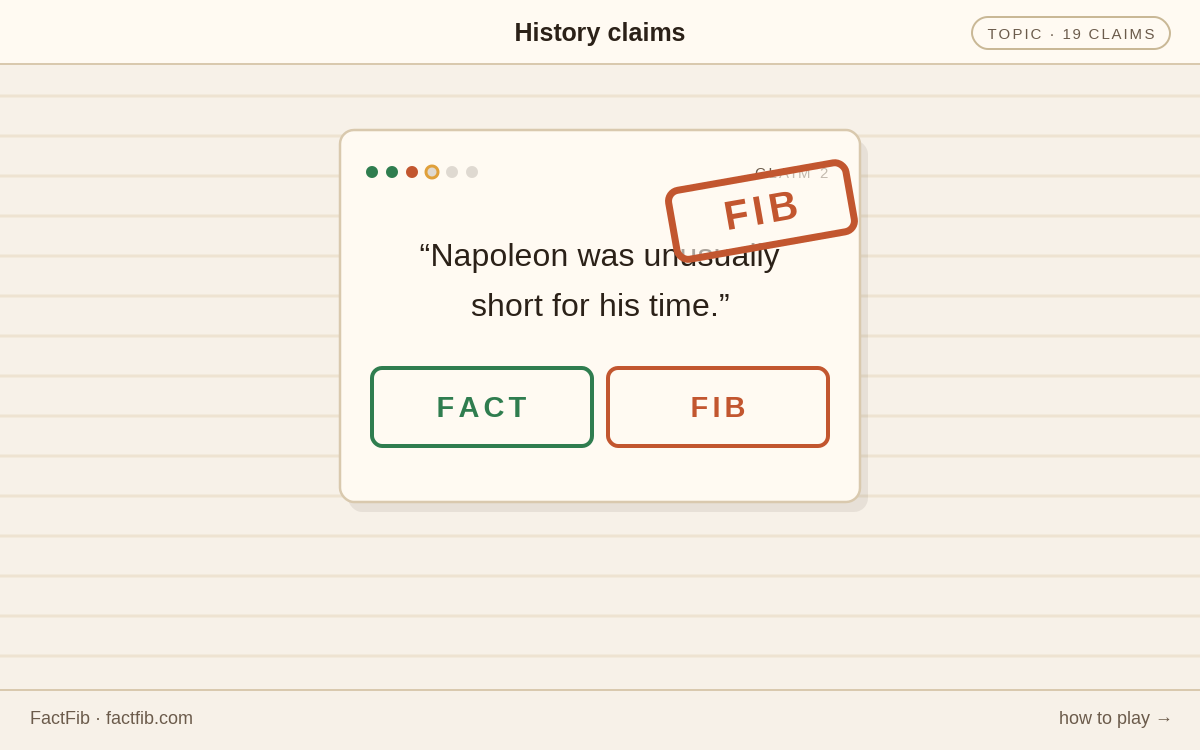
History fibs survive because they're better stories than what happened. "Let them eat cake" is a line Rousseau wrote before Marie Antoinette even arrived in France — it traveled to the most hated queen available and stayed there. Horned Viking helmets are nineteenth-century opera costumes. Napoleon was average height; the "little emperor" was British propaganda doing its job.
The true claims in this file are the ones that feel wrong. Cleopatra really did live closer to the Moon landing than to the pyramid's construction. Oxford really was lecturing before the Aztec Empire existed. Nintendo really was dealing playing cards in 1889. History's real timeline is stranger than its legend — which is what makes this file worth playing.
The pattern to watch
History fibs have fingerprints: a quote pinned to the most famous name available, a costume designer's invention repeated as archaeology, an absolute word ("always fought to the death") that economics makes impossible. When a claim ends with a neat moral, check who benefits from telling it that way.
History true or false questions, with answers
Ten from the file — every history claim with its full explanation and source lives on the sources page.
- Napoleon Bonaparte was unusually short for his time. — FIB: about 5'7" — average then; British propaganda shrank him.
- Viking warriors wore horned helmets. — FIB: a 19th-century opera costume; no excavated battle helmet has horns.
- Cleopatra lived closer to the Moon landing than to the Great Pyramid. — FACT: ~1,970 years forward versus ~2,530 back.
- Oxford University was teaching before the Aztec Empire existed. — FACT: documented by 1096; Tenochtitlan founded 1325.
- The US Declaration of Independence was signed on July 4, 1776. — FIB: the text was approved that day; most signatures came August 2.
- Albert Einstein failed mathematics at school. — FIB: he excelled from childhood; a grading-scale mix-up spawned the myth.
- Marie Antoinette said 'let them eat cake'. — FIB: Rousseau wrote the line before she arrived in France.
- Medieval scholars believed the Earth was flat. — FIB: educated Europe knew it was round since the Greeks.
- Nintendo was founded in 1889 as a playing-card company. — FACT: hanafuda cards in Kyoto, decades before toys.
- Thomas Edison invented the light bulb. — FIB: he built the first commercially practical one; Swan and others had working bulbs earlier.
Closed the record books? The animal file has its own brand of legend, go interrogate today's daily case, or read the complete list of fact or fiction questions with answers — spoilers inside.
FAQ
What era do the history claims cover?
Everything from the Great Pyramid to Nintendo's card-game founding — the point is not a period, it's how legends get made.
How do you verify a historical claim?
The same way historians do — against primary records and standard references (National Archives, museum collections, Britannica). Each claim's source is shown after the verdict.
Why do so many famous 'facts' turn out to be fibs?
Most were propaganda, opera costumes or a novelist's flourish that outlived its source. The tells section of each claim names the actual origin.
Is the daily case different?
The daily case mixes history claims in with every other topic — this file is for concentrating on the legends alone.
Where can I find history true or false questions with answers?
Right here — ten are listed above, and the sources page carries all 19 history claims with verdicts, explanations and named sources.
Detective notes
No notes yet — which claim caught you today?