The science file
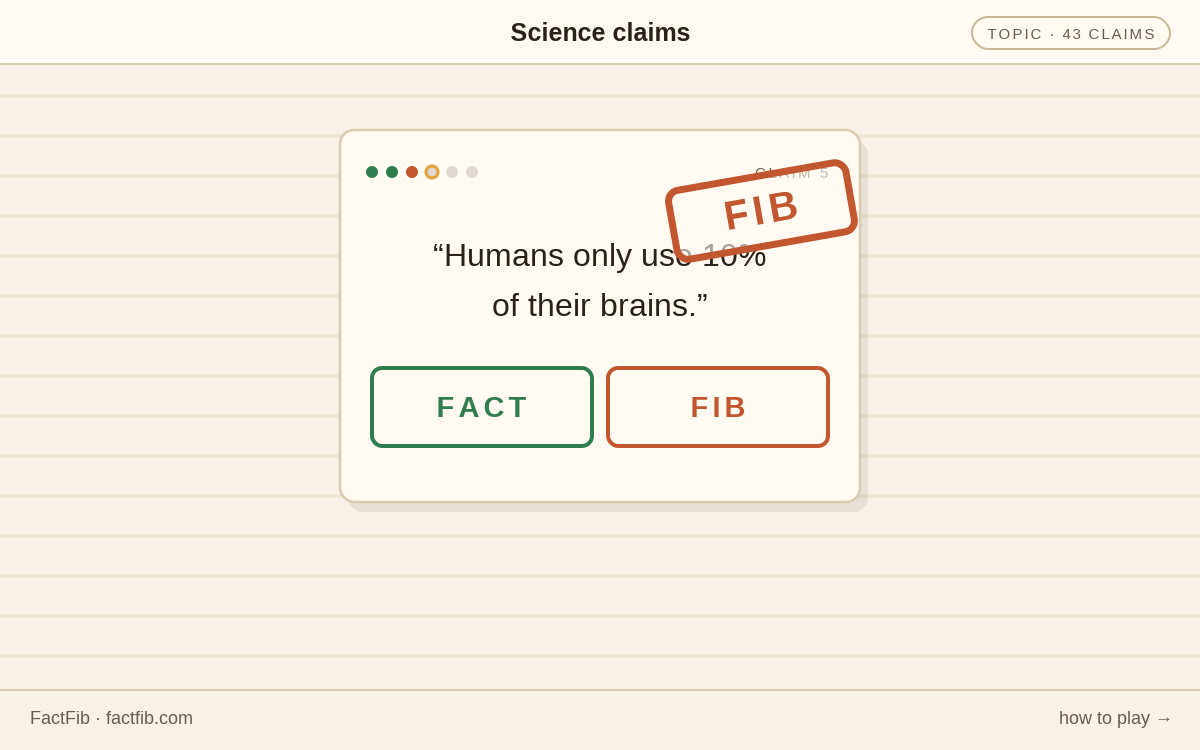
Science fibs are the most durable on the internet because they sound like they came from a textbook — and some of them did. The tongue map is a mistranslation from 1901 that survived a century of reprinting. "Glass is a liquid" is a misunderstanding of medieval window-making that kept circulating long after museums explained the panes. "We use ten percent of our brains" is a self-help statistic with no neuroscience behind it at all.
The space section plays the opposite trick: the facts sound invented. Venus's day outlasts its year. A teaspoon of neutron star weighs billions of tons. All the planets fit between Earth and the Moon — on average. Learning to tell "sounds crazy but hedged" (true) from "sounds crazy and absolute" (usually a fib) is the core skill.
The pattern to watch
Science fibs thrive on two devices: the proverb phrased as a law ("lightning never strikes twice"), and the true fact attached to a false conclusion ("we share DNA with bananas, which proves…"). The body section adds a third: rules for everyone that physiology never promised — eight glasses, eight spiders, five senses.
Science true or false questions, with answers
Ten from the file — every claim with its full explanation and source lives on the sources page, under the Science and Space sections.
- Humans use only 10 percent of their brains. — FIB: imaging shows nearly every region active across a normal day.
- Lightning never strikes the same place twice. — FIB: the Empire State Building takes 20–25 strikes a year.
- You can see the Great Wall of China from space with the naked eye. — FIB: astronauts confirm you can't pick it out even from low orbit.
- A day on Venus lasts longer than a year on Venus. — FACT: a ~243-day rotation inside a ~225-day orbit.
- The Sun is yellow. — FIB: it emits white light; the atmosphere scatters the blue away.
- Glass is a slow-flowing liquid. — FIB: it's an amorphous solid; old panes were just made uneven.
- All the planets could fit between Earth and the Moon. — FACT: ~380,000 km of planet inside a ~384,400 km gap — on average.
- A teaspoon of neutron star material would weigh billions of tons. — FACT: matter crushed to atomic-nucleus density.
- Saturn would float in a bathtub big enough to hold it. — FACT: density about 0.69 g/cm³ — less than water.
- Antibiotics cure the flu. — FIB: flu is a virus; antibiotics only act on bacteria.
Finished the lab? The history file trades lab coats for legends, take today's daily case, or read the full list of fact or fiction questions with answers — spoilers inside.
FAQ
What does the science file cover?
Physics and chemistry (lightning, glass, conductors), space (the Moon, Venus, black holes) and the human body (senses, cells, sneezes).
Are these real science facts?
Every claim carries a named source — NASA, NOAA, Britannica, published studies — and the sources page lists the full file with explanations.
Is there overlap with the daily case?
Daily case files draw from the whole deck, so some claims will resurface — that is part of the game, watching yourself call them faster the second time.
Can I keep score?
Your running tally shows when you close out the session. The daily case is the competitive one — this file is for training the eye.
Where can I find science true or false questions with answers?
Right here — ten are listed above, and the sources page carries the full science file (plus space and the human body) with verdicts, explanations and named sources.
Detective notes
No notes yet — which claim caught you today?